
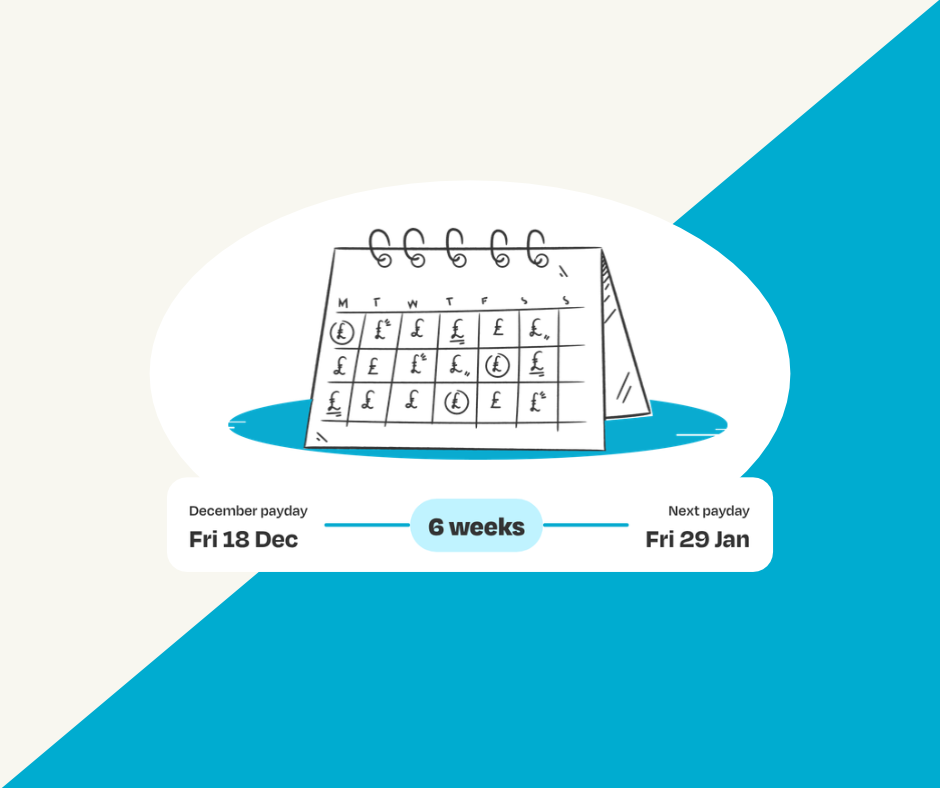
TL;DR: January is the longest wait between paydays for many UK employees, often stretching to six weeks once December's early payroll runs are factored in. Combined with post-Christmas spending, this creates acute financial stress that affects productivity, absenteeism, and retention. Employers who offer Earned Wage Access can help staff manage this gap without relying on high-cost credit.
For most employees in the UK, January isn't just cold and dark – it's financially difficult. December payroll often lands early to accommodate the festive break, which means the gap between that payment and the next one in January can stretch well beyond the usual four weeks. Add in holiday spending, New Year sales temptation, and the return of regular bills (which are often higher than normal), and you've got a recipe for serious financial strain.
Employers who overlook this seasonal squeeze risk more than a few stressed-out staff. Financial pressure has a direct line to workplace performance, and January is when that pressure peaks.
Why is the gap between December and January pay so long?
Many UK payroll cycles bring December's pay date forward by several days to account for bank holidays and office closures. While this is a helpful gesture for both employees and payroll at Christmas, it has a knock-on effect: employees often wait five to six weeks before their next payday in January, rather than the usual four.
For someone living pay cheque to pay cheque, an extra week or two without income can mean missed bill payments, reliance on credit cards, or turning to high-interest short-term loans. This isn't a minor inconvenience; it's a genuine cash flow crisis repeated every single year.
How does financial stress in January affect employers?
Financial wellbeing and workplace performance are closely linked. According to research from the Chartered Institute of Personnel and Development (CIPD), financial stress is one of the leading causes of reduced productivity and increased absenteeism among UK employees.
When staff are worrying about how to cover rent, childcare, or utility bills, their attention drifts from the job in hand. The effects typically show up as:
Reduced productivity: financial anxiety is mentally taxing and makes it harder to focus.
Increased absenteeism: stress-related sick days tend to rise during financially tight periods.
Higher staff turnover: employees under sustained financial pressure are more likely to look elsewhere, particularly to employers offering better pay or more flexible financial support.
January, with its unique combination of a longer pay gap and post-Christmas debt, amplifies all three.
What can employers do to support staff through the January pay gap?
Choose Earned Wage Access if you want to give employees flexibility without altering your payroll cycle or increasing business costs. Earned Wage Access, also known as On-Demand Pay, allows employees to access wages they've already earned before the scheduled payday, rather than waiting for the standard monthly cycle to catch up.
This is particularly valuable in January, when the usual gap between paydays is extended. Rather than turning to credit cards or payday loans to bridge the shortfall, employees can draw down a portion of wages they've genuinely earned.
Level FT's Earned Wage Access platform integrates with the payroll and HR systems employers already use, including SAP, IRIS, Shape, Planday, Deputy, Rota King, Rotageek, OneTouch, and Nourish, with new integrations added regularly and bespoke options available for specific business needs. This means implementation doesn't require overhauling existing payroll infrastructure.
Why does this matter beyond January?
The January pay gap is a seasonal spike, but financial stress doesn't disappear once the month ends. Employers that introduce Earned Wage Access as a standing benefit, rather than a one-off January fix, give employees a tool that supports financial resilience all year round. This consistency builds trust and signals that an employer genuinely understands the pressures staff face.
Supporting employees through the longest month
January will always be a financially demanding month for UK workers, but employers aren't powerless to help. Understanding why the pay gap occurs, and recognising its knock-on effects on productivity, absenteeism, and retention, is the first step toward addressing it meaningfully.
Earned Wage Access offers a practical, low-friction way to ease this pressure, giving employees access to wages they've already earned without disrupting payroll operations. For employers looking to support their workforce through January and beyond, it's worth exploring how On-Demand Pay could fit into existing HR and payroll systems.
Frequently asked questions
What is the January pay gap?
The January pay gap refers to the extended wait between December and January pay dates, caused by employers moving December payroll earlier to accommodate the Christmas break. This can stretch the usual four-week pay cycle to five or six weeks.
How does the January pay gap affect employee wellbeing?
The combination of a longer wait for pay and post-Christmas spending creates heightened financial stress, which research links to reduced productivity, increased absenteeism, and higher staff turnover.
What is Earned Wage Access?
Earned Wage Access, also called On-Demand Pay, allows employees to draw down wages they have already earned before their scheduled payday, rather than waiting for the standard payroll cycle.
Does Earned Wage Access require changing our payroll system?
No. Level FT's Earned Wage Access platform integrates with widely used payroll and HR systems, including SAP, IRIS, Shape, Planday, Deputy, Rota King, Rotageek, OneTouch, and Nourish, with bespoke integrations also available.
Is Earned Wage Access only useful in January?
No. While the January pay gap highlights an acute need, Earned Wage Access provides ongoing financial flexibility throughout the year, helping employees manage cash flow whenever unexpected costs arise.